
Entdecken Sie die Hauptmerkmale der nächsten Generation des quantitativen TOF-Monitorings.
Das erste Level-of-Block Gauge™ und TetraGraph® Adaptive Intelligence™
TetraGraph basiert auf Milliarden von Datenpunkten und wird durch die EMGINE™ Software unterstützt. Intelligentes Design und höchste Präzision tragen dazu bei, die Abläufe im Operationssaal effizient zu gestalten.
Das exklusive TetraGraph Level-of-Block Gauge™ erleichtert die Interpretation der Messdaten in allen Phasen der Anästhesie und unterstützt eine optimale Patientenversorgung.
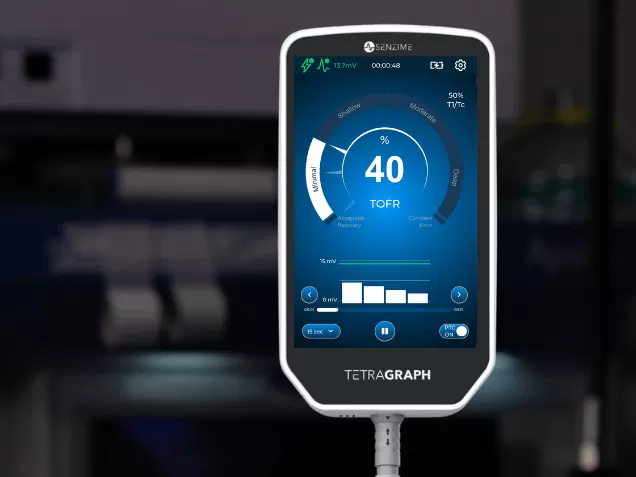
Willkommen zur neuen TetraGraph Generation
Basierend auf jahrzehntelanger wissenschaftlicher Forschung, durch reale Patientendaten von Tausenden von Patienten optimierten Algorithmen sowie dem exklusiven Level-of-Block Gauge™ setzt TetraGraph Next-Generation neue Maßstäbe im neuromuskulären Monitoring.
Bringing the next-generation TetraGraph into our community hospital has transformed how we manage neuromuscular block.
It has improved patient safety, standardized our practices, and reduced our annual drug spend by more than $100,000.
- Dr. Aaron Persinger
Anesthesiologist, Boulder Valley Anesthesiology Medical Director, UCHealth Broomfield Anesthesiology Medical Director, Pre-Anesthesia Testing Clinic, UCHealth Broomfield

Willkommen in der Zukunft – schon heute
Warum TetraGraph?
Revolutionieren Sie die Relaxometrie mit den fortschrittlichen quantitativen Train-of-Four (TOF)-Funktionen des TetraGraph, die eine unvergleichliche Genauigkeit in der neuromuskulären Überwachung bieten.
Mit seinem schlanken, tragbaren Design fügt sich TetraGraph nahtlos in jede dynamische OP-Umgebung ein. Unterschiedliche Befestigungsmöglichkeiten und vielseitige Konnektivitätslösungen sorgen für maximale Flexibilität und Benutzerfreundlichkeit.
Unterstützt durch die EMGINE™ Software bietet TetraGraph Algorithmen, die auf Basis realer Patientendaten optimiert wurden.
Mit dem Level-of-Block Gauge™ und der TetraGraph® Adaptive Intelligence™ stellt TetraGraph eine optimale Signalstärke und eine präzise neuromuskuläre Überwachung sicher – auch bei tiefer Blockade oder nach Verabreichung von Muskelrelaxanzien.
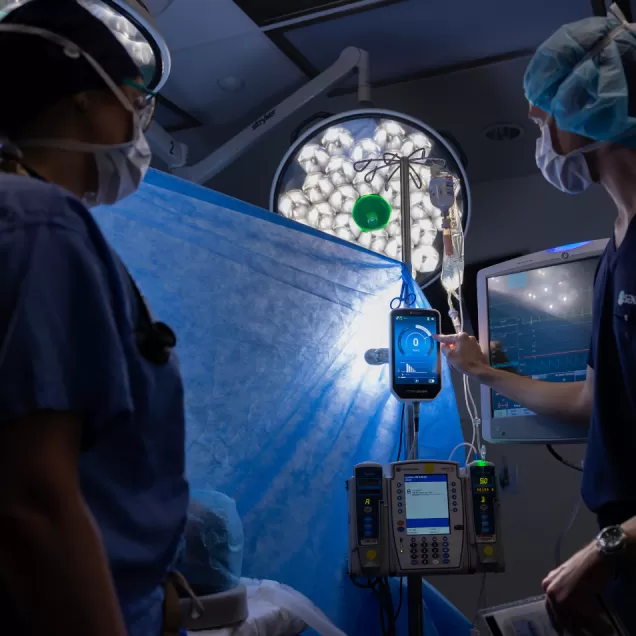
EMG für höchste Genauigkeit
Erhöhen Sie Patientensicherheit und Patientenoutcome
Residuale neuromuskuläre Blockaden (rNMB) bleiben eine Herausforderung in der perioperativen Versorgung, die zu erhöhten postoperativen Komplikationen, verlängerten Erholungszeiten und höheren Gesundheitskosten beitragen.
Das EMG-basierte Monitoring des TetraGraph ist eine zuverlässige Lösung durch Echtzeitbewertungen der neuromuskulären Überwachung und höchster Präzision. Konform mit den Guidelines der ASA und ESAIC werden Protokolle zur Verbesserung der Patientensicherheit unterstützt.
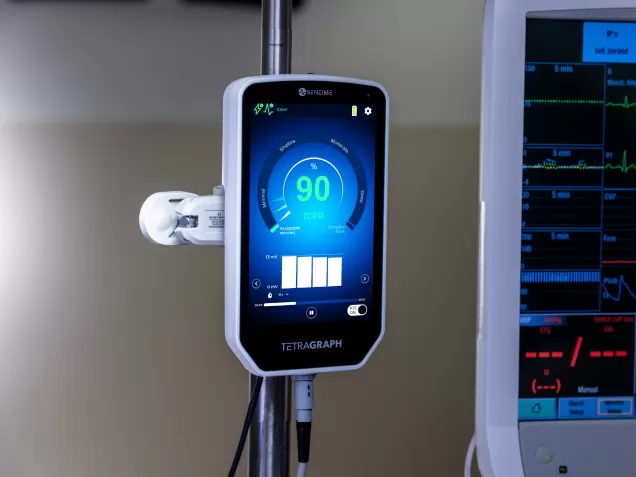
Einfach intelligent
TetraGraph unterstützt perioperative Entscheidungen
TetraGraph verfügt über eine intuitive Benutzeroberfläche zur einfachen Analyse von Trenddaten und unterstützt Anwender dabei, fundierte klinische Entscheidungen während der gesamten perioperativen Phase zu treffen. Die intelligente EMG-Analyse mit Peak-to-Trough (PtT)-Analytik ermöglicht eine optimal patientenzentrierte Versorgung – unabhängig von der Komplexität des Eingriffs.
Im Gegensatz zu anderen Monitoren, die zusätzliche (Erdungs-) Elektroden zur Rauschunterdrückung benötigen, integriert TetraGraph eine patentierte Noise-Cancelling-Technologie. Unterstützt durch die EMGINE™ Software gewährleistet sie saubere und präzise Messdaten.
Intelligentes und vielseitiges Patientenmonitoring
Priorität in der Entwicklung war die Vielseitigkeit, daher passt sich TetraGraph nahtlos an jede OP-Umgebung an. Konnektivitätslösungen zu externen Patientenmonitoren und Patientendatenmanagementsystemen maximieren die Effizienz und verbessern die Patientenversorgung.
Unsere flexiblen EMG-Sensoren und Befestigungsoptionen unterstützen verschiedene chirurgische Eingriffe, einschließlich solcher mit eingeschränktem Platz und begrenzter Bewegungsfreiheit der Gliedmaßen, wie bei angelagerten Armen oder roboterassistierten Eingriffen.
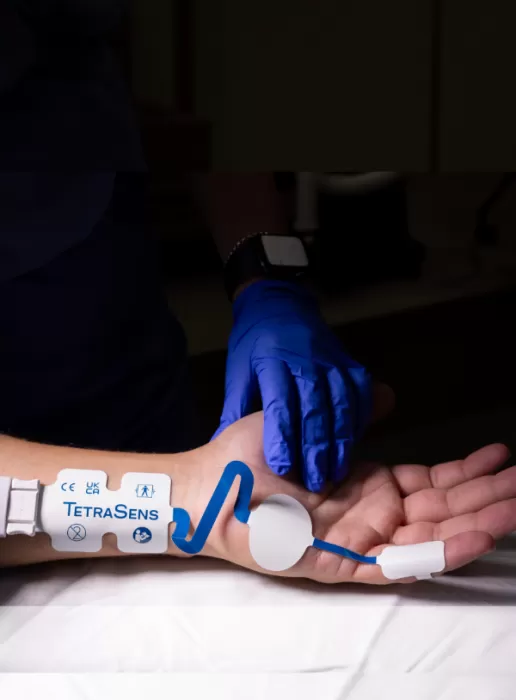
TetraSens
Anpassbar für erwachsene Patienten. Ermöglicht eine präzise neuromuskuläre Überwachung für ein breites Spektrum chirurgischer Eingriffe.
TetraSens Pediatric
Ultrasoftes, flexibles Material und der einzige zugelassene EMG-Sensor mit einer separaten und spezifischen Indikation für pädiatrische Patienten. Ein Sensor für den Einsatz von Säuglingen bis hin zu Jugendlichen.
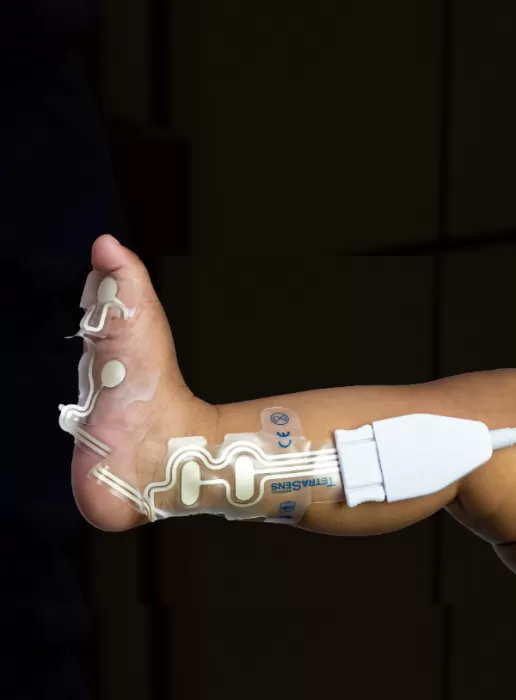
Exklusive TetraGraph® Adaptive Intelligence™
Hoch entwickelte Algorithmen automatisieren den gesamten Arbeitsablauf – von der Einleitung bis zur Erholung.
Intuitive Benutzeroberfläche für bessere Übersichtlichkeit
TetraGraph bietet eine intuitive Benutzeroberfläche, mit der Patientendaten-Trends übersichtlich angezeigt und analysiert werden können. Dies unterstützt dabei, fundierte Entscheidungen zu treffen und ermöglicht ein effizientes Patientenmanagement während des gesamten perioperativen Zeitraums – sowohl in Echtzeit als auch rückblickend.
TetraGraph EMG vs konventioneller AMG Überwachung
| TetraGraph EMG | AMG | |
|---|---|---|
| Basiert auf quantitativer Monitortechnologie | Yes | Yes |
| Misst das Muskelsummenaktionspotenzial | Yes | No |
| Kein Zugang zum Daumen oder Hand notwendig | Yes | No |
| Für alle Arten von Operationen | Yes | No |
| Überwacht zuverlässig alle Patienten, auch pädiatrische Patienten | Yes | No |
| Exakte Messungen ohne Normalisierung – kein Reverse-Fade-Phänomen. | Yes | No |
| Zuverlässige Beurteilung der Erholungsphase ohne Überschätzung. | Yes | No |
Choosing the right TOF monitor?
Our buyer's guide compares quantitative and qualitative monitoring technologies, outlines five essential evaluation criteria, and quantifies the impact on patient outcomes and total cost of care.
Entdecken Sie die leistungsstarke EMG-Technologie
TetraGraphs neuromuskuläre Überwachung auf Basis der Elektromyographie (EMG) misst das erste Signal, das nach der neuromuskulären Übertragung erfasst werden kann, und bietet somit die präziseste verfügbare Technologie.
Erfahren Sie im Video, wie es funktioniert!
Wählen Sie TetraGraph für höchste Genauigkeit und Präzision
Aktuelle klinische Studien belegen die überlegene Genauigkeit und Präzision des TetraGraph als verlässliche Wahl für das quantitative TOF-Monitoring.
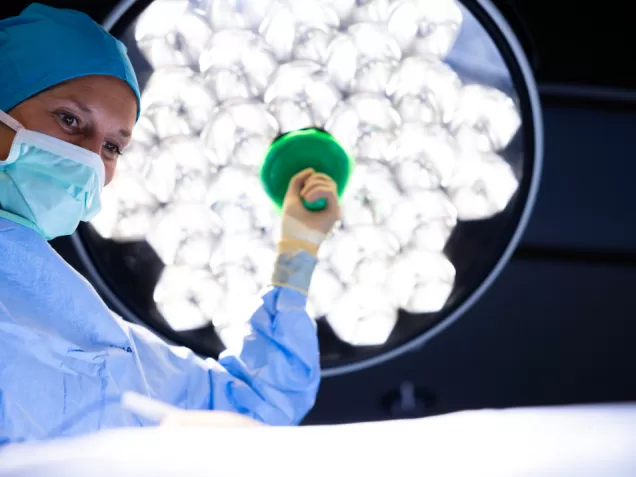
Wählen Sie TetraGraph
Eine nachhaltige, zukunftssichere Lösung
TetraGraph wird mit umweltfreundlichen Materialien und einem fossilfreien Energieherstellungsprozess entwickelt, was unser Engagement für Nachhaltigkeit widerspiegelt.
Seine richtungsweisensende Technologie ist offen für zukünftige Softwarefunktionen. So ist sichergestellt, dass der TetraGraph immer den neuesten Anforderungen entspricht.
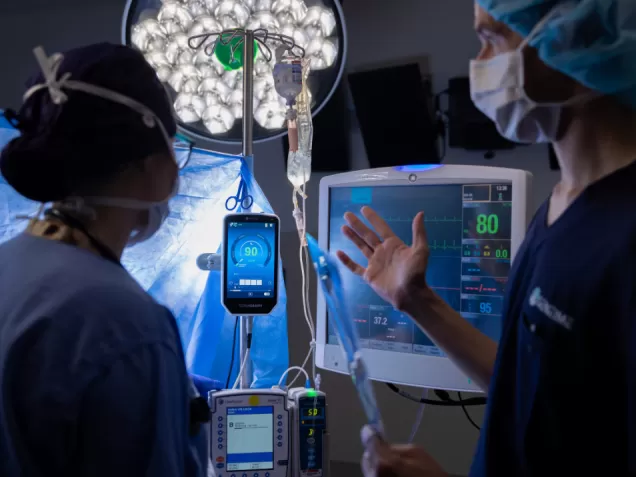
Relaxomatrie direkt - durch Elektromyographie
Erleben Sie den TetraGraph Vorteil
TetraGraph ist mehr als nur ein Produkt – es ist eine umfassende Lösung, die entwickelt wurde, um Ihre anästhesiologische Routine zu verbessern. Von der Einleitung bis zur Erholung bietet TetraGraph Echtzeitwerte und Unterstützung, um eine sicherere und effizientere Patientenversorgung zu gewährleisten.
Erleben Sie die Zukunft heute!
Mehr
Produktbroschüre
Ein vollständiger Überblick über die neue TetraGraph Generation, einschließlich technischer Spezifikationen
Optimierung Ihrer täglichen Routine
Erfahren Sie mehr über die neuesten Guidelines, starten Sie mit der quantitativen TOF-Relaxometrie und erhalten Sie wertvolle Erkenntnisse zur Verbesserung des Patientenoutcomes.
TetraGraph ist ein klinisch umfassend untersuchtes System.
- Nazira W, Villalobosa EE, Padillaa SP, Mavesa G, Tobias JD, Quantitative Train-of-Four Monitoring Using the TetraGraph to Evaluate Rocuronium Requirements During Renal Transplantation in a Pediatric Patient, J Med Cases. 2025;16(9):331-336
- Danielsons S, Welter J, Dullenkopf A, 2025, Observational Cohort Study of TetraGraph® Electromyography Compared to Standard Acceleromyography Monitoring, Journal of clinical medicine - Volume 14, Issue 17, pp
- Chaney A, Villalobos EE, Rice-Weimer J, Tobias JD, Intraoperative Electromyographic Monitoring in Children Less Than 1 Year of Age, Paediatric anaesthesia - Volume 35, Issue 11, pp. 934-939
- Werner, Sarah J., Georgevici, Adrian I., Weber, Thomas P., Klutzny, Mitja, Dencks, Stefanie, Oblisz, Nico, Gude, Philipp, Herzog-Niescery, Jennifer, Quantifying the effect of succinylcholine on vocal cord opening using electromyographic single twitch for facilitated mask ventilation: a prospective observational study, Trends in Anaesthesia and Critical Care - Volume 62, Issue 0, pp. 101564
- Herzog-Niescery J, von der Gönna M, Werner S, Weber T and Georgevici A, The electromyographic single twitch stimulation for monitoring the effect of rocuronium on vocal cord opening – a randomised controlled trial
- Asztalos L, Boktor M, Kukuly M, Sólyom D, Pongrácz A, Brull S, Fülesdi B, The Relationship Between Neuromuscular Block Depth and Airway Retroglossal Area: A Prospective, Nonrandomized, Observational Clinical Trial
- Hernandez V, Chaves-Cardona H, Rivero A, Matus M, Logvinov I, Brull S, Renew J, Comparison of adductor pollicis and flexor hallucis brevis muscle electromyographic responses: a prospective cohort study
- Fülesdi B, Luterán P, Boktor M, Asztalos L, Nagy G, Brull SJ, Molnár C. Time Course of a Single, 0.6 mg/kg Dose of Rocuronium Neuromuscular Block During Sevoflurane or Propofol Anesthesia in Infants—A Prospective, Randomized Trial. Journal of Clinical Medicine. 2025; 14(18):6459.
- Wedemeyer Z, Michaelsen KE, Jelacic S, Silliman W, Lopez A, Togashi K, Bowdle A Accuracy and Precision of Three Acceleromyographs, Three Electromyographs, and a Mechanomyograph Measuring the Train-of-four Ratio in the Absence of Neuromuscular Blocking Drugs Anesthesiology - Volume 141, Issue 2, pp. 262-271 2024.
- Epstein RH, Nemes R, Renew JR, Brull SJ Area under the curve and amplitude of the compound motor action potential are clinically interchangeable quantitative measures of neuromuscular block: a method comparison study BJA open - Volume 11, Issue , pp. 100293 – 2024.
- Ebert TJ, Vogt JA, Kaur R, Iqbal Z, Peters DJ, Cummings CE, Stekiel TA. Train-of-four ratio, counts and post tetanic counts with the TetraGraph electromyograph in comparison to mechanomyography. Journal of clinical monitoring and computing - Volume , Issue , pp. Online ahead of print - 2024
- Tobias JD, Epstein RH, Rice-Weimer J, Yemele Kitio SA, Brull SJ, Kalsotra S. Pediatric Intraoperative Electromyographic Responses at the Adductor Pollicis and Flexor Hallucis Brevis Muscles: A Prospective, Comparative Analysis. Anesthesia and analgesia - Volume 139, Issue 1, pp. 36-43 - 2024
- Haberkorn S, Twite M, Klockau K, Whitney G, Faulk DJ. Quantitative Monitoring Maximizes Cost-Saving Strategies When Antagonizing Neuromuscular Block With Sugammadex. Cureus - Volume 16, Issue 9, pp. e68551 -2024
- Espinal LM, Kalsotra S, Rice-Weimer J, Kitio SAY, Tobias JD. Tolerance to preoperative placement of electrodes for neuromuscular monitoring using the TetraGraph. Saudi journal of anaesthesia - Volume 18, Issue 2, pp. 205-210 – 2024
- Verdonck M, Carvalho H, Fuchs-Buder T, Brull SJ, Poelaert J. Machine learning based analysis and detection of trend outliers for electromyographic neuromuscular monitoring. Journal of clinical monitoring and computing - Volume 38, Issue 5, pp. 1163-1173, 2024
- Kalsotra et al, 2023 Intraoperative electromyographic monitoring in children using a novel pediatric sensor. Saudi journal of anaesthesia - Volume 17, Issue 3, pp. 378-382 - published 2023-07-01
- Chaves-Cordona et al, 2023 Comparison of onset of neuromuscular blockade with electromyographic and acceleromyographic monitoring: a prospective clinical trial. Brazilian journal of anesthesiology (Elsevier) - Volume 73, Issue 4, pp. 393-400 - published 2023-07-01
- Renew et al, 2023 Comparison of visual and electromyographic assessments with train-of-four stimulation of the ulnar nerve: a prospective cohort study. Canadian journal of anaesthesia - Volume 70, Issue 5, pp. 878-885 - published 2023-05-01
- Iwasaki et al, 2023 The impact of electrosurgical devices on electromyography-based neuromuscular monitoring during abdominal laparotomy: a case series. Journal of clinical monitoring and computing - Volume 37, Issue 4, pp. 1111-1114 - published 2023-08-01.
- Owuso-Bediako et al, 2022, Feasibility of intraoperative quantitative neuromuscular blockade monitoring in children using electromyography Saudi J Anaesth. 2022 Oct-Dec; 16(4): 412–418.
- Sato et al. Comparison of two electromyography-based neuromuscular monitors, AF-201P and TetraGraph, in rocuronium-induced neuromuscular block: A prospective comparative study. Anaesth Crit Care Pain Med. 2022 Aug 31;41(6):101145
- Iwasaki et al. A Comparison Between the Adductor Pollicis Muscle Using TOF-Watch SX and the Abductor Digiti Minimi Muscle Using TetraGraph in Rocuronium-Induced Neuromuscular Block: A Prospective Observational Study. Anesth Analg. 2022 Aug 1;135(2):370-375
- Giorgio Giudici, Federico Piccioni, Paolo Proto, Franco Valenza, A comparison of accelerometric monitoring by TOF Watch® SX and electromyographic monitoring by TetraGraph for recovery from neuromuscular blockade, Journal of Clinical Anesthesia, Volume 75, 2021,110481
- Nemes, R, Lengyel, S, Nagy, G., Hampton, D.R., Gray, M, Renew J.R., Tassonyi, E, Fülesdi, B, Brull S.J., Ipsilateral and Simultaneous Comparison of Responses from Acceleromyography- and Electromyography-based Neuromuscular Monitors. Anesthesiology, 2021, Newly published on July 30
- Renew JR, Hernandez-Torres V, Logvinov I, Nemes R, Nagy G, Li Z, Watt L, Murphy GS, Comparison of the TetraGraph and TOFscan for monitoring recovery from neuromuscular blockade in the Post Anesthesia Care Unit., J Clin Anesth, 2021, Aug;71:110234
- Renew JR, Hex K, Johnson P, Lovett P, Pence R. Ease of Application of Various Neuromuscular Devices for Routine Monitoring. Anesth Analg. 2021 May 1;132(5):1421-1428. Nemes R, Nagy G, Murphy GS, Logvinov II, Fülesdi B, Renew JR. Awake Volunteer Pain Scores During Neuromuscular Monitoring. Anesth Analg. 2020 Apr;130(4):941-948.
Abstracts with TetraGraph
- S Paredes, A Smith, L Puertas-Ocio, E villalobos, W Nazir, S A Y Kitio, J Rice-Weimer, J D Tobias, Train-of-four monitoring using (TetraGraph ) to evaluate rocuronium infusion requirements during major surgery, 2025
- Villalobos 2025 - Intraoperative Neuromuscular Monitoring Electromyography Monitor vs. PNS- Does the Face Lie
- A Chaney, E Villalobos, J Rice-Weimer, J.D. Tobias, Intraoperative electromyographic monitoring in children less than 1 year of age 2025
- S Waite, P Raju, G Rodney, Measurement of System Usability- validating the system usability score within anaesthesia 2024
- J Herzog-Niescery, S Werner, S Dencks, T Weber, A Georgevici, Quantifizierung de suciinylcholin-Wirkung auf die Stimmbandöffnungsfläche mittels electromyografischem signle twitch monitoring, 2024
- E Villalobos, S padilla, Sj Brull, J Tobias, Intraoperative Neuromuscular Monitoring: Electromyography Monitor Versus Peripheral Nerve Stimulator – Does the Face Lie? A Case Report.2024
- P Frykholm, Delayed onset of atracurium detected by neuromuscular monitoring with the TetraGraph paediatric electrodes. First experience with a new device in small children.2024
- S Haberkorn, M Twite, K Klockau, G Whitey, A Quality Improvement Project to Reduce Sugammadex Cost and Waste by Using Aliquots and Quantitative Neuromuscular Monitoring SPA 2023
- R Kaur, J vogt, E Shibly, D peters, Z Iqbal, S Gandhi, T Ebert, Validation clinical important neuromuscular monitoring endpoints: Mechanomyography vs. electromyograph IARS 2023
- RH Epstein, R Nemes, JR Renew, SJ Brull, Optimization of the Timing of Laryngoscopy Using Quantitative Neuromuscular Blockade Monitoring: An Exploratory Analysis, Anesthesiology 2022.
- P Majou, C Meistelman, S Brull Comparison of the TOFscan and the TetraGraph during recovery of neuromuscular block : a pilot study, 2022
- J Renew, V Hernandez-Torres, R Nemes, G Murphy, Multicenter study comparing the ToFscan and TetraGraph during Recovery of Neuromuscular Function in the Post Anesthesia Care Unit 2021
- R Munch, J Mathias, J Tobias, K Owusu-Bediako, Characteristics of quantitative train-of-four monitoring in children using electromyography.
- L Puertas-Ocio, J Tobias, K Owusu-Bediako. Intraoperative pediatric neuromuscular monitoring in laparoscopic (restricted arm access) surgical setting.
- K Owusu-Bediako, S Kim, J Rice-Weimer, J Tobias, Feasibility Of Pediatric Neuromuscular Monitoring In Laparoscopic (restricted Arm Movement) Surgical Settings
- M Twite, B Smith, R Ing. The use of Quantitative Neuromuscular Monitoring to Understand Neuromuscular Blockade, Re-dosing, Reversal and Residual Blockade in Children undergoing Cardiac Catheterization Procedures
- K Owusu-Bediako, S Kim, J Rice-Weimer, J Tobias, Quantitative Train-of-four Monitoring In Pediatric Patients Using Electromyography. Anesthesiology 2021.
- V Hernandez, H Chaves-Cardona, A Rivero, M Matus, JR Renew, SJ Brull. Comparison of adductor pollicis and flexor hallucis brevis muscles (thumb vs. great toe) as sites for neuromuscular monitoring with electromyography after sugammadex antagonism. Anesthesiology 2021
- V Hernandez, H Chaves-Cardona, M Restrepo-Holguin, JR Renew, SJ Brull. Electromyography for the detection of residual neuromuscular block in clinical practice: a systematic review and meta-analysis. Anesthesiology 2021.
- JR Renew, V Hernandez-Torres, R Pence, SJ Brull. Comparison of visual and electromyography assessments in response to train-of-four stimulation of the ulnar nerve. Anesth Analg. Presented IARS 2021.
- V Hernandez, H Chaves-Cardona, JR Renew, SJ Brull. Electromyographic And Acceleromyographic Monitoring In Restricted Arm Movement Surgical Setting. A Prospective, Randomized Trial. Anesthesiology 2021; A2069
- A Creighton, D Kim, S Liang, P A Stewart, Comparison of two muscles using a novel electromyographic device to assess recovery from muscle relaxants in patients undergoing general anaesthesia. ASA NCS 2019
- R Nemes, J. Renew Comparison of Electromyography Derived Train-Of-Four Ratios of the Adductor Pollicis and Abductor Digiti Minimi Muscles and Their Comparison to Acceleromyography Derived Train-Of-Four Ratios, STA meeting
- J Renew , A Donaldson , I Logvinov , R Chadha , R McClain , R Nemes, Comparative Investigation Of AMG- And EMG-Based Neuromuscular Monitors, P-9113, 2018 NY PGA