
In the delicate balance of anesthesia, precision is your power.
Every year, millions suffer from residual paralysis, tripling the risk of complications. Prevent this risk with quantitative neuromuscular TOF monitoring.
Residual neuromuscular block (RNMB), or residual paralysis, is a serious postoperative complication that potentially can lead to critical respiratory events.
Despite increased awareness, the incidence of RNMB is reported to be high, in the range of 20%. (1)
Postoperative Pulmonary Complications among patients with RNMB is 3-times higher compared with patients without RNMB. (2)
The length of stay in PACU increase by 80 minutes in patients with TOF ratios < 0.9. (3)
The cost to treat one pneumonia case is $ 6,042. (4, 5)
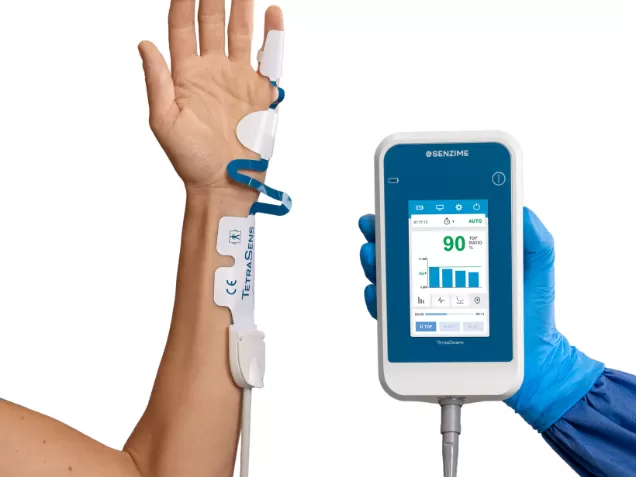
- Compliant with 2023 ASA guidelines for neuromuscular blockade monitoring
- Easy to use with one-button start, no hassle getting it into your workflow
- Accurate, validated data, powered by unique EMG algorithm based on 40+ years of research
- Trusted technology, used by thousands of clinicians worldwide
TetraGraph is designed for those who refuse to compromise on patient safety.
Contact us to request a complimentary demo, discuss the latest in clinical literature, and explore how TetraGraph can help you elevate your practice.

Quantitative neuromuscular monitoring is strongly recommended in the 2023 clinical guidelines from ASA and ESAIC.
The use of EMG-based quantitative monitoring - the most accurate clinical technique - has been proven to be the most accurate technology, helping optimize reversal agent dosing and improve patient safety. (Reference 6,7)
Commit to making residual paralysis a zero event today! Choose quantitative monitoring for your next case.
How to get to zero?
The only way to ensure that the incidence of residual neuromuscular blockade is 0 % is to make sure that there is no residual blockade.
And the only way to do that is to use quantitative monitoring with a monitor that is reliable enough to tell you when the train-of-four ratio of 0.9 has been reached.
Dr. Sorin J. Brull, MD FCARCSI (Hon)
Professor Emeritus of Anesthesiology & Perioperative Medicine, Mayo Clinic, USA
1. Thilen SR, Sherpa JR, James AM, Cain KC, Treggiari MM, Bhananker SM. Management of Muscle Relaxation With Rocuronium and Reversal With Neostigmine or Sugammadex Guided by Quantitative Neuromuscular Monitoring. Anesth Analg. 2023
2. Edwards et al; Universal Quantitative Neuromuscular blockade monitoring at an acamdeic medical center – a multimodal analysis of the potential impact on clinical outcomes and total cost of care, perioperative care and OR management, 2021
3. Butterly A et al, Postoperative Residual Curarization from inter-mediate acting neuromuscular blocking agents delays recovery from discharge. BR J Aneast; 2010.
4. Cammu G - Residual Neuromuscular Blockade and Postoperative Pulmonary Complications: What Does the Recent Evidence Demonstrate? Curr Anesthesiol Rep. 2020.
5. Bulka CM,Terekhov MA, Martin BJ, Dmochowski RR, Hayes RM, Ehrenfeld JM. Nondepolarizing neuromuscular blocking agents, reversal, and risk of postoperative pneumonia. Anesthesiology 2016
6. Grabitz SD, Rajaratnam N, Chhagani K, et al. The effects of postoperative residual neuromuscular blockade on hospital costs and intensive care unit admission: a population-based cohort study. Anesth Analg. 2019
7. Nemes et al- Ipsilateral and Simultaneous comparison of responses from Acceleromyography- and Electromyography-based Neuromuscular Monitors. Anesthesiology 2021