
From Guesswork to Measurable Gains
How Quantitative TOF Monitoring Elevates Quality Improvement
March 27, 2026
Blog by Amanda Kingery, RN, BSN, CNRN, Clinical & Medical Affairs Coordinator at Senzime
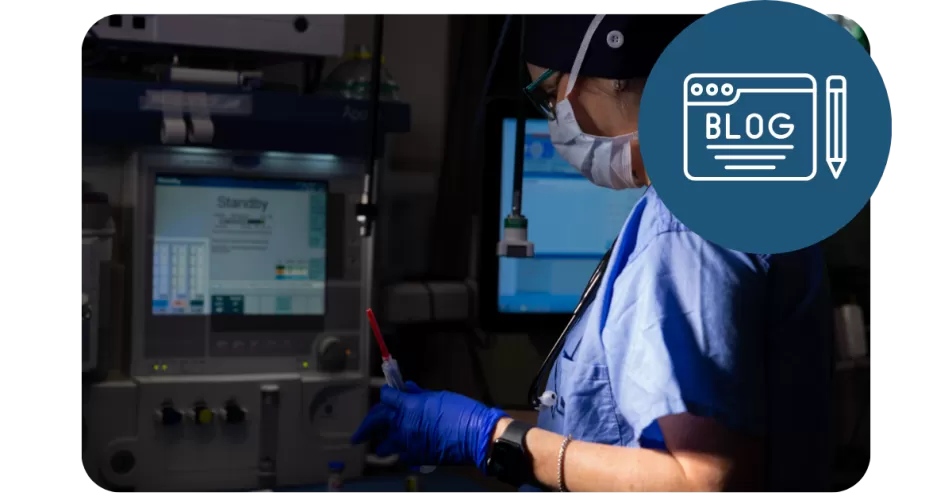
In today’s ORs, quality improvement (QI) isn’t just about fixing what’s broken — it’s about using data to make care measurably safer. And few areas illustrate that shift better than quantitative train-of-four (TOF) monitoring.
For decades, anesthesia teams have relied on neuromuscular blocking agents (NMBAs) to ensure optimal surgical conditions. While their use is routine, the way we assess recovery has been anything but standardized. Despite years of awareness, residual neuromuscular block (rNMB) remains a quiet but costly problem — contributing to postoperative airway obstruction, hypoxemia, reintubation, and pulmonary complications that can directly affect QI metrics and patient safety scores.
Why it matters
Those complications aren’t just numbers on a dashboard — they represent real patients whose recoveries could have been smoother, safer, and faster. A 2022 study found that by incorporating quantitative TOF monitoring, pulmonary complications were reduced by 43%, along with a 1-day decrease in hospital length of stay (Weigel et al., 2022).
The truth is, many of these events are preventable when recovery is confirmed with objective data rather than subjective observation.
Where quantitative TOF changes the game
Traditional qualitative (or “subjective”) monitoring — feeling or watching for twitches — depends heavily on operator skill and perception. It’s simple but inconsistent, and studies show that up to 30% of patients (Carvalho et al., 2020) monitored this way still experience rNMB (or residual paralysis) postoperatively.
Quantitative monitoring, on the other hand, delivers real numbers instead of rough estimates, enabling clinicians to appropriately dose reversal agents. A recent dose-finding study revealed that 87% of patients required less sugammadex, whereas 13% needed additional dosing based on quantitative TOF monitoring data (Bowdle et al., 2022).
EMG-based systems like Senzime’s TetraGraph provide an exact train-of-four (TOF) ratio, allowing anesthesia teams to confirm full recovery (TOF ≥ 0.9) before extubation.
That difference isn’t just about precision — it’s about creating actionable data that can be integrated into departmental QI dashboards.
Suddenly, recovery isn’t an assumption; it’s measurable, reportable, and improvable.
Turning data into improvement
When hospitals integrate quantitative TOF monitoring into their QI programs, they can begin tracking key performance indicators that directly reflect quality and safety:
1. Patient Safety Metrics
- Fewer cases of residual paralysis and related respiratory complications
- Reduced postoperative pulmonary events
- Lower reintubations and unplanned ICU transfer rates
2. Process and Compliance Metrics
- Higher compliance with American Society of Anesthesiology (ASA) practice guidelines
- Standardized NMBA monitoring documentation within the electronic health records (EHR)
- Improved adherence to appropriate reversal agent use
3. Operational and Financial Metrics
- Shorter PACU stays and fewer unplanned readmissions
- Reduced pharmaceutical waste and complication-related costs
- Measurable improvement in provider-to-provider consistency
A smarter way forward
Transitioning from qualitative to quantitative TOF isn’t just adopting new technology — it’s embracing a smarter, safer standard of care.
By replacing subjective interpretation with objective, reproducible data, anesthesia teams can better protect patients, meet QI benchmarks, and showcase measurable progress in safety and outcomes.
The takeaway? While every twitch tells a story, it’s time to start listening to the data for safer, more informed decisions.
Any questions or feedback? Want to learn more how datapoints on quantitative TOF monitoring? Contact me and my colleagues.
Amanda Kingery, RN, BSN, CNRN, Clinical & Medical Affairs Coordinator at Senzime

- Weigel WA, Williams BL, Hanson NA, et al. “Quantitative Neuromuscular Monitoring in Clinical Practice: A Professional Practice Change Initiative.” Anesthesiology, 2022; 136(6):901-915. DOI: 10.1097/ALN.0000000000004174
- Carvalho H, et al.: Forty years of neuromuscular monitoring and postoperative residual curarisation: a meta-analysis and evaluation of confidence in network meta-analysis. Br J Anaesth. 2020 Oct;125(4):466-482.
- T. Andrew Bowdle, Kishanee J. Haththotuwegama, Srdjan Jelacic, Sharon T. Nguyen, Kei Togashi, Kelly E. Michaelsen; A Dose-finding Study of Sugammadex for Reversal of Rocuronium in Cardiac Surgery Patients and Postoperative Monitoring for Recurrent Paralysis. Anesthesiology 2023; 139:6–15 doi: https://doi.org/10.1097/ALN.0000000000004578