From Guesswork to Readiness: Rethinking the Moment of Intubation
May 26, 2026
Blog by Michael Noble, Chief Marketing Officer at Senzime

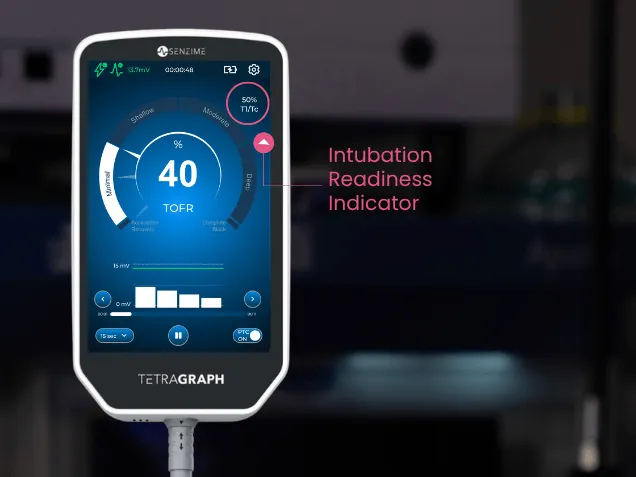
The Intubation Readiness Indicator in the next-generation TetraGraph introduces an objective way to assess when neuromuscular block is sufficient to proceed with airway management.
Powered by EMGINE, it leverages accurate electromyography to move beyond time-based assumptions and subjective assessment, providing clinicians with real-time insight during induction. At its core is the T1/Tc ratio, which compares the amplitude of the first twitch after train-of-four stimulation to the patient’s own baseline control twitch, allowing each patient to serve as their own reference point. As this ratio decreases, it reflects deepening neuromuscular block and signals when acceptable intubating conditions are likely to be achieved. This matters because the onset of neuromuscular block is highly variable between patients, and relying on fixed timing can lead to suboptimal intubating conditions.
By translating neuromuscular data into a clear, actionable signal, the Intubation Readiness Indicator supports more consistent, data-driven decision-making at a critical moment in anesthesia.
In a prospective, randomized trial by Ross Renew, MD, of Mayo Clinic, and colleagues, intubation guided by quantitative neuromuscular monitoring resulted in significantly better conditions compared to a fixed time approach, with 73% achieving ideal conditions versus 57% in the time-based group (Renew et al., 2026). The study also demonstrated a meaningful correlation between depth of block and intubating conditions, underscoring the value of objective measurement.
As Ross Renew, MD, of Mayo Clinic, explains,
“T1/TC considers the ratio of the amplitude of the first twitch (T1) following train-of-four (TOF) stimulation to the amplitude of the baseline control twitch (TC).
As each patient serves as his or her own control, T1/TC is independent of the arbitrary threshold that a specific device manufacturer selects for what their monitor considers a twitch. This measurement provides valuable insight during onset of neuromuscular block and can indicate when acceptable intubating conditions have been achieved.
Lower T1/TC values correlate with a higher likelihood of acceptable intubating conditions and most patients have acceptable intubating conditions once T1/TC is less than 0.2.”

Together, these findings support a fundamental shift from estimating readiness based on time to confirming it with patient-specific data.
Stop guessing. Start knowing when to intubate.
Explore the clinical evidence behind objective intubation timing.
Download the Ross Renew clinical summary to see how quantitative monitoring improves intubating conditions.
Experience how the Intubation Readiness Indicator works in real time.
Michael Noble, Chief Marketing Officer at Senzime
If you have any further questions or require additional information, feel free to contact me and my colleagues.