
TOF Monitoring for Ambulatory Surgery Centers: Compliance, Safety, and ROI

Ambulatory surgery centers face unique operational risks from residual neuromuscular block, where even a single failed extubation can lead to an unplanned admission and lost revenue.
This guide outlines why quantitative TOF monitoring is essential for compliance with 2023 American Society of Anesthesiologists guidelines, how EMG solves ASC-specific workflow challenges, and what implementation looks like in practice. It also breaks down the ROI, showing how ASCs can improve patient safety while reducing drug costs and avoiding costly complications.
Ambulatory surgery centers (ASCs) face the same clinical obligations as hospitals, but with fewer resources and tighter margins. As case volumes grow and turnover accelerates, ensuring safe neuromuscular recovery is both a clinical and operational priority.
Train-of-four (TOF) monitoring is no longer optional. It is essential for compliance, patient safety, and cost control in modern ASC environments.
Why ASCs Cannot Afford to Skip Quantitative TOF Monitoring
Residual neuromuscular block (rNMB) in ambulatory patients creates a unique operational risk: unplanned admission.
Unlike hospitals, ASC PACUs are not equipped to manage intubated patients. If a patient cannot be safely extubated due to residual paralysis:
- The case may require hospital transfer
- The ASC risks losing the surgical fee
- Documentation and quality reporting are triggered
- CMS performance metrics may be impacted
The 2023 guidelines from the American Society of Anesthesiologists apply equally to ASCs, requiring quantitative monitoring and confirmation of TOF ≥0.9 before extubation. (1)
Despite this, adoption remains limited. In a 2025 SAMBA presentation, only 49% of anesthesia providers report using quantitative monitoring (2), leaving many ASCs exposed to avoidable risk.
The Unique Monitoring Challenges of Ambulatory Cases
ASC workflows amplify the limitations of traditional monitoring approaches.
- Cases typically last 1–3 hours, leaving limited time for spontaneous recovery
- Patients are discharged within hours, making residual paralysis at discharge a serious safety concern
- Positioning (lithotomy, lateral) often limits access to the hand, making AMG unreliable
Even standard dosing carries variability:
- Rocuronium (0.6 mg/kg) has a clinical duration ranging from 15 to 85 minutes (3)
This variability makes subjective assessment unreliable.
EMG-based monitoring solves these challenges by:
- Measuring electrical activity directly
- Working reliably in tucked-arm and constrained positions
- Providing objective data across all phases of recovery
In ambulatory settings, EMG is not just preferred—it is operationally necessary.
Implementing quantitative monitoring in an ASC requires a simple, repeatable workflow:
1. Device availability
- Quantitative monitor in every anesthetizing location
2. Rapid setup
- Pre-induction start-up in <60 seconds with EMG
3. Objective extubation criteria
- Confirm TOF ≥0.9 before extubation
- Document in EMR or anesthesia record
4. Data-guided reversal
- Reversal agent selection based on measured depth of block
5. Staff competency
- Consistent training across anesthesia providers
Modern systems also support documentation:
This ensures compliance without adding workflow burden.
ROI for ASCs: The Numbers
For ASCs, the financial case for quantitative monitoring is immediate and measurable.
Baseline scenario:
- 5,000 general anesthetics per year
- Rocuronium used routinely
Reversal cost savings:
- ~20% of patients achieve spontaneous recovery without reversal4
- 1,000 patients avoid sugammadex annually
- Estimated savings: $50,000–$110,000 per year
Net savings with sensors:
- Sensor cost: ~$27 per case → $230,000 annually
Net savings remain positive at typical sugammadex pricing
Validated benchmark:
- ~$46 per-case net savings demonstrated in clinical practice (4)

Additional economic drivers:
- Reduced NMBA re-dosing
- Fewer PACU complications
- Faster discharge and improved throughput
Even more importantly:
- Avoiding just 2–3 unplanned admissions per year can offset device acquisition costs entirely
Larger system data reinforces the direction:
- One study projected annual cost savings of $370K (4)
“Bringing the next-generation TetraGraph into our community hospital has transformed how we manage neuromuscular block.
It has improved patient safety, standardized our practices, and reduced our annual drug spend by more than $100,000.”
- Dr. Aaron Persinger, Anesthesiologist, Boulder Valley Anesthesiology Medical Director, UCHealth Broomfield Anesthesiology Medical Director, Pre-Anesthesia Testing Clinic, UCHealth Broomfield
For ASCs, quantitative monitoring is one of the few interventions that improves safety while reducing cost.
TetraGraph for ASCs: Why Standalone EMG Works Best
ASC environments require solutions that are simple, scalable, and independent.
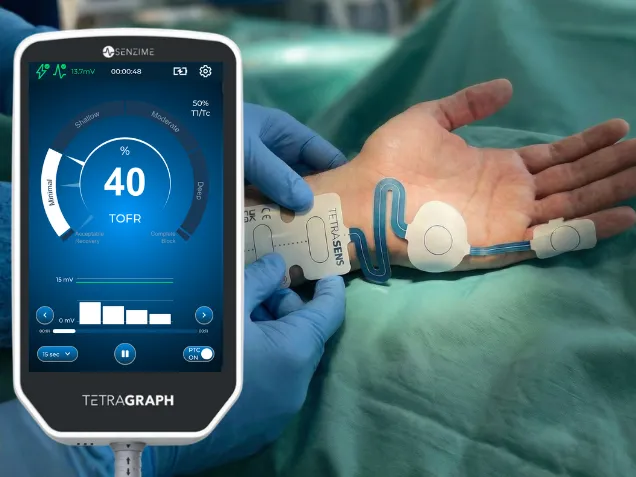
TetraGraph is designed specifically for these constraints:
- Standalone system
No need for integration into hospital-wide monitoring infrastructure - Simple setup
Single-use TetraSens® electrode
No preload or thumb positioning - Compact footprint
Ideal for multi-OR ASC layouts - Scalable connectivity
TetraCom enables optional EMR integration as needs evolve - Proven performance
Equivalent with clinical reference MMG for TOF ratio (Wedemeyer et al., 2024) and validated across all levels of block (Ebert TJ et al., 2024)
This combination allows ASCs to implement quantitative monitoring quickly, without adding complexity.
Quantitative TOF monitoring is now the standard of care and a clear financial opportunity for ASCs.
Calculate Your ASC’s Monitoring ROI
to estimate your facility’s savings.
Request ASC Pricing for TetraGraph
to evaluate implementation options.
- Thilen SR, Weigel WA, Todd MM, et al. 2023 American Society of Anesthesiologists Practice Guidelines for Monitoring and Antagonism of Neuromuscular Blockade: A Report by the American Society of Anesthesiologists Task Force on Neuromuscular Blockade. Anesthesiology. 2023;138(1):13–41. doi:10.1097/ALN.0000000000004379
- Lebak, Kelly, et al. Neuromuscular Blockade Monitoring Practices and Barriers to Adopting Current ASA Guidelines in Ambulatory Surgery Settings. Society for Ambulatory Anesthesia (SAMBA) Annual Meeting, 2025.
- Debaene, Bruno, et al. “Residual Paralysis in the PACU after a Single Intubating Dose of Nondepolarizing Muscle Relaxant with an Intermediate Duration of Action.” Anesthesiology, vol. 98, no. 5, 2003, pp. 1042–1048.
- Haberkorn S, Faulk DJ, et al. “Quantitative Monitoring Maximizes Cost-Saving Strategies When Antagonizing Neuromuscular Block with Sugammadex.” Cureus, 2024; 16(9): e68551. DOI: 10.7759/cureus.68551
- Ebert TJ, Vogt J, Kaur R, Iqbal Z, Peters D, Cummings CE, Stekiel TA. Train-of-four ratio, counts and post-tetanic counts with the TetraGraph electromyograph in comparison with mechanomyography.. Journal of Clinical Monitoring and Computing, August 2024.