
Train-of-Four Monitoring: Complete Buying Guide 2026
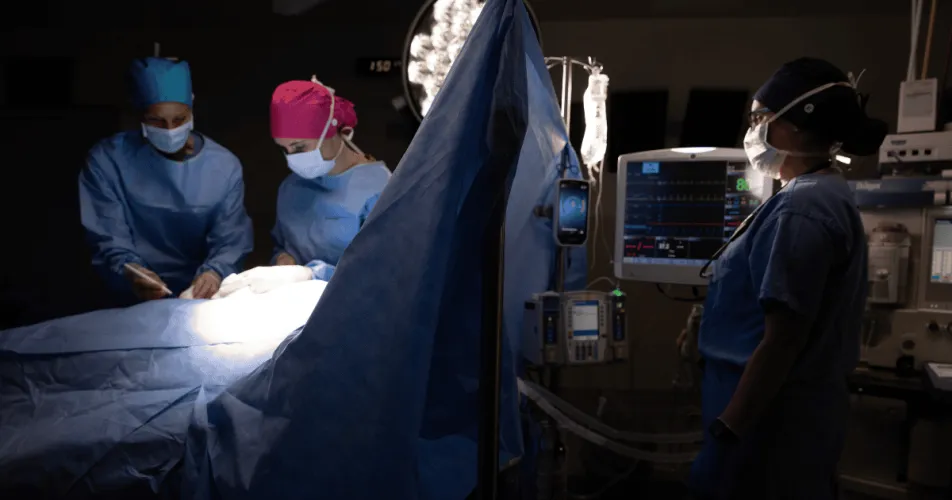
Train-of-four (TOF) monitoring is now a clinical and operational necessity, driven by the 2023 American Society of Anesthesiologists guidelines and the high incidence of residual neuromuscular block without objective monitoring.
This guide breaks down the key differences between qualitative and quantitative monitoring, outlines the five criteria for evaluating TOF devices, and compares leading solutions. It also quantifies the financial impact, showing how EMG-based monitoring improves outcomes while reducing total cost of care.
Train-of-four (TOF) monitoring is no longer optional. Residual neuromuscular block (rNMB) can affect up to 33% of patients without monitoring (1). As hospitals align with updated guidelines and reduce complications, choosing the right TOF monitor is a critical decision for clinicians and procurement teams.
Why the 2023 ASA Guidelines Changed TOF Monitoring Requirements
The 2023 American Society of Anesthesiologists (ASA) practice guidelines mark a clear shift in neuromuscular monitoring standards (2):
- Quantitative monitoring is strongly recommended over qualitative assessment
- Confirm a TOF ratio ≥0.9 before extubation
These changes raise the standard of care. Facilities relying on peripheral nerve stimulators (PNS) and subjective assessment are not aligned with guidelines, as qualitative methods cannot reliably detect rNMB in the critical recovery range.
As a result, guideline adherence is increasingly tied to:
- Patient safety
- Complication rates
- Institutional quality reporting
For hospitals, this is not just clinical preference, it is a compliance and risk management issue.
Qualitative vs. Quantitative TOF Monitoring: What’s Actually Different
The core limitation of qualitative monitoring is simple: it cannot detect what matters most.
Fade is not reliably visible until the TOF ratio drops below 0.4, creating a “blind zone” from 0.4 to 0.9 where patients may appear recovered but remain impaired.
Clinical impact:
- 40–60% postoperative residual curarization (PORC) incidence with qualitative monitoring (3)
- 0% rNMB achievable with quantitative monitoring (4)

Technology differences matter:
Acceleromyography (AMG):
- Requires free thumb movement
- Prone to overestimation (baseline >110%)
- Requires normalization
Electromyography (EMG):
- Measures electrical activity directly
- Works in tucked arms, laparoscopic, and robotic cases
- No normalization required
The evidence is clear: EMG delivers more reliable, clinically actionable data in real-world OR conditions.
The 5 Clinical Criteria for Evaluating a TOF Monitor
This checklist ensures decisions are driven by clinical performance, not familiarity or price.
These five criteria should guide evaluation when comparing TOF monitoring devices:
EMG preferred, especially robotic and tucked-arm cases
Proven accuracy vs. mechanomyography (MMG) from deep block (PTC) through recovery
Must include Single Twitch (ST), TOF, and Post-Tetanic Count (PTC)
Seamless connectivity with systems like Epic and Oracle Health (Cerner)
Real-time HL7 data capture
Single-use, easy placement
No free-thumb requirement
Consistent signal quality
TetraGraph vs. Competing Monitors: Feature Comparison
| Feature | TetraGraph | TwitchView 2 | Stimpod 450X+ |
| Technology | EMG | EMG | EMG + AMG |
| Visual depth-of-block guidance | Yes | No | No |
| Display Signal Strength to give insight into stimulation quality | Yes | Yes | No |
| Estimated Signal Strength if starting case post-paralytic | Yes | No | No |
| Intubation readiness guidance | Yes | No | No |
| Trend views | 3 | 1 | 0 |
| Accuracy | 97.9%* 5 | 95.3%*6 | 97.2%* 7 |
| Tucked-arm use | Yes | Yes | only EMG mode |
| Automatic Deep Block Mode | Yes | Yes | Manual |
| EMR integration | HL7 connectivity (Epic, Oracle), and other partners’ patient monitors | Epic, Cerner, Innovian and other EHR integrations; Blink states an open-interface commitment | Limited |
| FDA clearance | K190795 / K220530 | Yes | Yes |
*Calculated as 1-Bias vs. MMG
- Equivalent with clinical reference MMG for TOF ratio (5)
- Validated EMG-only system across all levels of block, especially deep block
- Automated workflow features
- TetraCom platform enabling universal HL7 connectivity
Making the Business Case: What Procurement Needs to Know
Procurement decisions should focus on total cost of ownership, driven by drug use, complications, and downstream resource utilization.
1. Drug Utilization and Reversal Cost Reduction
Quantitative monitoring changes reversal agents use:
- ~20% of patients achieve spontaneous recovery without reversal (8)
- 70% reduction in reversal drug costs (4)
- Sugammadex dosing variability without monitoring:
- 87% overdosed (9)
- 13% underdosed (9)
Result: wasted drug spend and increased patient risk.
2. Residual Block Reduction and Risk Avoidance
- High rNMB rates persistent without monitoring (10-11)
- Near zero rNMB achieved with EMG-based monitoring (4)
Impact: improved patient safety, recovery quality, and institutional quality metrics.
3. Postoperative Pulmonary Complication (PPC) Reduction (Largest Cost Driver)
- PPCs remain common without monitoring (12)
- Risk reduced from ~11.3% to ~3.5% with quantitative protocols (13-15)
Each PPC drives:
- Increased length of stay (16)
- Higher ICU admission risk (12)
- Significant incremental cost (17-19)
4. ICU Utilization and Escalation Costs
- rNMB linked to PACU complications and unplanned ICU admissions (12)
- ICU/ARDS care represents some of the highest-cost events (17)
Avoiding rNMB reduces ICU escalation and prolonged recovery.
5. Total Economic Impact at Scale
Combined impact:
- Lower drug spend
- Fewer PPCs
- Reduced ICU utilization
At 8,000–10,000 NMBA cases annually:
- ~ $370,000 annual drug savings (8)
- Multi-million-dollar savings when complications are included
Bottom line: Quantitative TOF monitoring is a high-ROI clinical intervention that reduces cost, risk, and variability.
“Bringing the next-generation TetraGraph into our community hospital has transformed how we manage neuromuscular block.
It has improved patient safety, standardized our practices, and reduced our annual drug spend by more than $100,000.”
- Dr. Aaron Persinger,
Anesthesiologist, Boulder Valley Anesthesiology Medical Director, UCHealth Broomfield Anesthesiology Medical Director, Pre-Anesthesia Testing Clinic, UCHealth Broomfield
The conclusion is straightforward:
Quantitative TOF monitoring is not a capital expense. It is a high-ROI clinical intervention that reduces variability, improves outcomes, and lowers total cost of care.
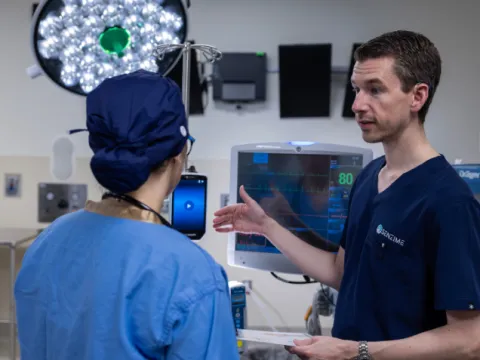
Choosing the right TOF monitor requires both clinical rigor and financial clarity.
Download the MMG vs. EMG clinical summary
to evaluate accuracy and support your internal decision process.
Request a TetraGraph Demo
to see how EMG-based monitoring performs in your OR environment.
Request access to our ROI Calculator
to get a custom ROI analysis and estimate potential annual savings.
Train-of-four (TOF) monitoring measures neuromuscular function by delivering four electrical stimuli and analyzing the muscle response to assess blockade and recovery.
The ASA recommends quantitative monitoring for all patients receiving neuromuscular blocking agents and confirms a TOF ratio ≥0.9 before extubation.
EMG measures electrical activity directly and works in all surgical conditions, while AMG measures movement and requires specific positioning, making it less reliable.
Please note: This page is intended for healthcare professionals. It is primarily tailored to the U.S. market, but may also be relevant for other regions.
- Carvalho H, et al.: Forty years of neuromuscular monitoring and postoperative residual curarisation: a meta-analysis and evaluation of confidence in network meta-analysis. Br J Anaesth. 2020 Oct;125(4):466-482.
- Thilen SR, Weigel WA, Todd MM, et al. 2023 American Society of Anesthesiologists Practice Guidelines for Monitoring and Antagonism of Neuromuscular Blockade: A Report by the American Society of Anesthesiologists Task Force on Neuromuscular Blockade. Anesthesiology. 2023;138(1):13–41. doi:10.1097/ALN.0000000000004379
- Murphy GS, Brull SJ. Residual neuromuscular block: lessons unlearned. Part I: definitions, incidence, and adverse physiologic effects of residual neuromuscular block. Anesth Analg. 2010 Jul;111(1):120-8. doi: 10.1213/ANE.0b013e3181da832d. Epub 2010 May 4. PMID: 20442260.
- Thilen SR, Sherpa JR, James AM, Cain KC, Treggiari MM, Bhananker SM. Management of Muscle Relaxation With Rocuronium and Reversal With Neostigmine or Sugammadex Guided by Quantitative Neuromuscular Monitoring. Anesth Analg. 2023 May 12.
- Ebert TJ, Vogt J, Kaur R, Iqbal Z, Peters D, Cummings CE, Stekiel TA. Train-of-four ratio, counts and post-tetanic counts with the TetraGraph electromyograph in comparison with mechanomyography.. Journal of Clinical Monitoring and Computing, August 2024.
- Bowdle A, Bussey L, Michaelsen K, Jelacic S, Nair B, Togashi K, Hulvershorn J. “A Comparison of a Prototype Electromyograph vs. a Mechanomyograph and an Acceleromyograph for Assessment of Neuromuscular Blockade.” Anaesthesia, vol. 75, 2020, pp. 187-195.
- Wedemeyer, Z., et al. “Comparative Performance of Stimpod Electromyography with Mechanomyography for Quantitative Neuromuscular Blockade Monitoring.” Journal of Clinical Monitoring and Computing, vol. 38, 2023, pp. 205-212.
- Haberkorn S, Faulk DJ, et al. “Quantitative Monitoring Maximizes Cost-Saving Strategies When Antagonizing Neuromuscular Block with Sugammadex.” Cureus, 2024; 16(9): e68551. DOI: 10.7759/cureus.68551
- Wanderer, Jonathan P., et al. “Goldilocks and the Three Rocuronium Reversals: A Sugammadex Dose-finding Study.” Anesthesiology, vol. 139, no. 1, May 2023, A16-A16, doi:10.1097/ALN.0000000000004610.
- Domenech, G., Kampel, M.A., García Guzzo, M.E. et al. Usefulness of intra-operative neuromuscular blockade monitoring and reversal agents for postoperative residual neuromuscular blockade: a retrospective observational study. BMC Anesthesiol 19, 2019.
- Kotake, Y. Reversal with sugammadex in the absence of monitoring did not preclude residual neuromuscular block. Anesth. Analg, 2013.
- Belcher AW, Leung S, Cohen B, et al. Incidence of complications in the post-anesthesia care unit and associated healthcare utilization in patients undergoing non-cardiac surgery requiring neuromuscular blockade 2005–2013: A single center study. J Clin Anesth. 2017;43:33–39.
- Kirmeier E, Eriksson LI, Lewald H, Wolfram K, Brieskorn M, et al. Post-anaesthesia pulmonary complications after use of muscle relaxants (POPULAR): a multicentre, prospective observational study. The Lancet Respiratory Medicine. 2019;7(2):129–140.
- Soukup J, Schilling T, Bein B, Zoremba N. Quantitatives neuromuskuläres Monitoring in der Allgemeinanästhesie: Realität und Perspektive. Die Anaesthesiologie. 2025;74(1):12–22.
- Weigel WA, Williams BL, Hanson NA, et al. Quantitative neuromuscular monitoring in clinical practice: a professional practice change initiative. Anesthesiology. 2022;136(6):901–915.
- Butterly A, et al.: Postoperative residual curarization from intermediate-acting neuromuscular blocking agents delays recovery room discharge.
Br J Anaesth 2010; 105:304–309. - Bice T, Cox CE, Carson SS. Cost and health care utilization in ARDS--different from other critical illness? Semin Respir Crit Care Med. 2013 Aug;34(4):529-36. doi: 10.1055/s-0033-1351125. Epub 2013 Aug 11. PMID: 23934722; PMCID: PMC4261619.
- McNelis, J., & Castaldi, M. (2014). "The National Surgery Quality Improvement Project" (NSQIP): a new tool to increase patient safety and cost efficiency in a surgical intensive care unit. Patient safety in surgery, 8, 19.
- Merkow RP, Shan Y, Gupta AR, Yang AD, Sama P, Schumacher M, Cooke D, Barnard C, Bilimoria KY. A Comprehensive Estimation of the Costs of 30-Day Postoperative Complications Using Actual Costs from Multiple, Diverse Hospitals. Jt Comm J Qual Patient Saf. 2020 Oct;46(10):558-564. doi: 10.1016/j.jcjq.2020.06.011. Epub 2020 Jul 3. PMID: 32888813; PMCID: PMC8822472.