
Trusted in Operating Rooms Around the Globe
Five Key Reasons Why Hospitals Standardize on TetraGraph
August 28, 2026
Blog by Philip Siberg, CEO at Senzime
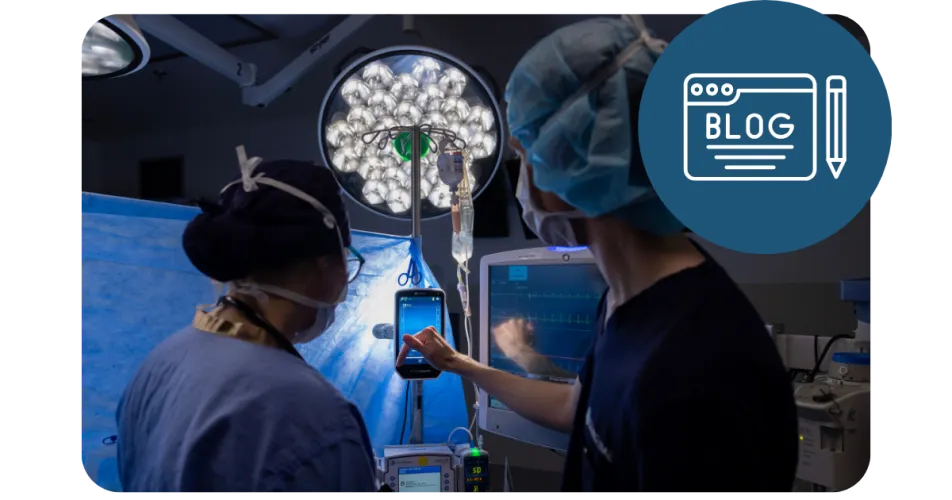
The evidence for quantitative neuromuscular monitoring has never been stronger. The next challenge is making it easy to adopt. Every patient, every procedure, every day.
In 2023, the American Society of Anesthesiologists issued a strong recommendation for quantitative neuromuscular monitoring over qualitative assessment to reduce the risk of residual neuromuscular block and recommended confirming a train-of-four ratio (TOFR) ≥0.9 before extubation. [1]
Yet translating guidelines into routine clinical practice remains a challenge.
A new survey of 915 anesthesia professionals who were ASA members found that only 19% consistently use quantitative neuromuscular monitoring, while 53% still don’t use it to confirm safe patient recovery. Perhaps most striking, 61% reported no change in their practice since publication of the ASA guidelines because they still do not use quantitative monitoring. Only 6% were unaware of the guidelines. [2]
The message is clear: awareness alone is not enough.
For quantitative monitoring to become routine, it must be readily available, trusted by clinicians, intuitive to use and easy to integrate into an already demanding anesthesia workflow. That is exactly what we have designed TetraGraph® to do. So why do hospitals around the world choose to standardize on TetraGraph? It comes down to five things: thoughtful design, proven science, comprehensive support, real-world experience, and trust.
1. Designed to Make the Right Thing the Easy Thing
Technology should simplify clinical practice, not add friction to it.
Previous research into clinician perceptions of quantitative neuromuscular monitors identified concerns including artifacts, inaccurate measurements, unintuitive design and challenges achieving reliable setups in certain surgical positions. The investigators concluded that accuracy, reliability and ergonomics should be priorities in the evolution of neuromuscular monitoring technology. [3]
We listened.
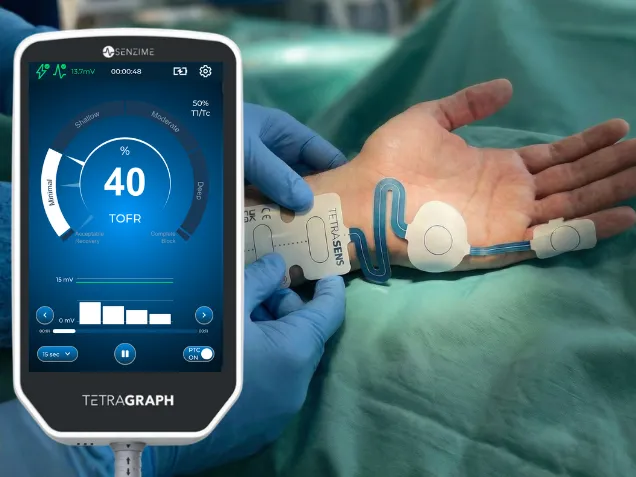
Our next-generation TetraGraph® was designed from the ground up around the realities of today's operating room: limited space, competing demands, tucked arms, rapidly changing conditions and clinicians who need meaningful information, not more complexity.
Its compact, portable design fits easily into crowded operating rooms, while EMG technology directly measures the electrical response of the muscle and does not depend on visible thumb movement. Independent research has demonstrated that EMG measurements can be obtained irrespective of hand and thumb position, an important practical advantage during surgery.[4]
At the center is the TetraGraph Level-of-Block Gauge™, which transforms TOF ratio, TOF count and post-tetanic count information into an intuitive visual representation of the patient's neuromuscular status, helping clinicians understand where the patient is along the continuum of neuromuscular block and recovery at a glance.
Importantly, the perception that quantitative monitoring must significantly slow workflow is not supported by the evidence. In a real-world evaluation involving experienced nurse anesthetists, investigators concluded that application and use of quantitative devices were relatively straightforward. TetraGraph also required no calibration, unlike acceleromyography-based devices.[5]
The goal is simple: remove as much friction as possible between the guideline and the clinician.
2. Built on Science, Not Assumptions
Ease of use means little if clinicians cannot trust the number on the screen.
The question, “Can I trust the data?”, has shaped every generation of TetraGraph.
TetraGraph builds on decades of neuromuscular monitoring research and combines advanced electromyography with proprietary signal-processing algorithms designed to provide reliable quantitative information from induction through recovery. Its performance has also been independently evaluated against mechanomyography (MMG), the traditional research reference standard.
In a prospective evaluation investigators analyzed 685 paired TOF-ratio measurements obtained simultaneously with TetraGraph EMG and validated MMG. The mean difference between the two technologies was just −2.1%. TOF counts were within two counts of MMG 96% of the time, while post-tetanic counts during deep block were within two counts 95% of the time. [4] The investigators concluded that the accuracy of TetraGraph supported quantitative EMG as a clinical standard across the onset, depth and reversal of neuromuscular block.
This is important because quantitative monitoring is not simply about producing another number. It is about providing clinicians with dependable information to guide decisions throughout anesthesia, from assessing neuromuscular block to guiding reversal and objectively confirming recovery.
3. From Data to Decisions
Quantitative monitoring can also support more individualized care.
In a prospective study of 189 patients, a protocol using quantitative monitoring to guide reversal-agent selection and confirm TOFR ≥0.9 before extubation resulted in zero cases of postoperative residual neuromuscular block in the study population. The monitoring-guided strategy also allowed selective use of neostigmine and sugammadex; projected drug acquisition costs would have been 70% higher if every patient had they not used quantitative neuromuscular monitoring. [6]
The recently published ASA-member survey reinforces why objective information remains important even in the era of sugammadex: 57% of respondents who primarily used sugammadex for reversal reported never using quantitative monitoring. The authors specifically cautioned against the belief that sugammadex eliminates the need for monitoring.
TetraGraph helps turn neuromuscular monitoring from an isolated measurement into actionable information throughout the anesthesia journey.
And with TetraAnalytics™, hospitals can move beyond the individual case to review utilization patterns, identify educational opportunities and support quality-improvement initiatives using objective monitoring data.
4. A Partner Beyond the Product
But we know that even the best technology does not change clinical practice by itself.
The 2026 ASA-member survey found that clinicians practicing where quantitative monitors were readily available were significantly more likely to increase their use. Its authors concluded that clinical guidelines should be considered a starting point rather than the finish line, calling for multifaceted education to drive practice change. There is good evidence that this support matters.
A separate study examining EMG implementation found that a focused educational intervention increased correct electrode placement from 74.5% to 95% at one placement point and from 61.8% to 96.7% at another. Provider confidence in the EMG-derived information increased from 67% to 90% following education. [7]
That is why Senzime's commitment does not end when a monitor arrives at the hospital.
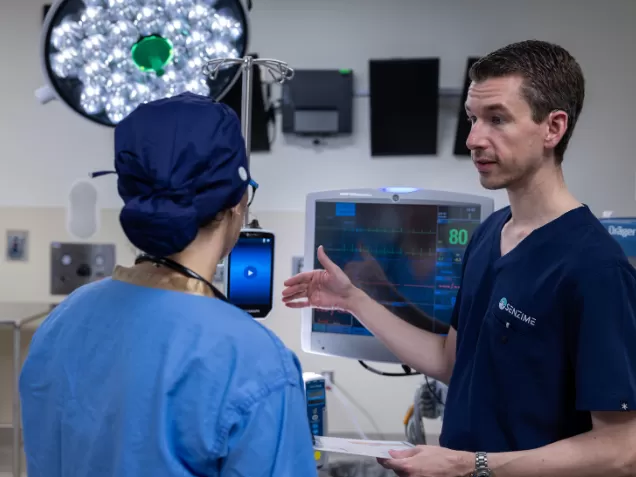
Our clinical and commercial teams work alongside customers to make implementation as frictionless as possible, from initial workflow assessment and stakeholder planning through clinical education, policy and protocol support, super-user development, sensor-placement training, connectivity and go-live support.
Clinicians also have access to on-site and virtual education, quick-reference tools, implementation resources and Senzime Academy for self-paced learning. Following implementation, our teams remain engaged to support adoption, troubleshoot workflow challenges and help institutions establish sustainable best practices for standardized quantitative neuromuscular monitoring.
We don't simply provide a monitor. We help hospitals make quantitative monitoring work in everyday practice.
5. Trusted from Induction to Recovery
The science supporting quantitative neuromuscular monitoring is increasingly clear.
The challenge now is translating evidence and guidelines into routine practice. That requires more than a recommendation. It requires technology clinicians can trust, a workflow they can embrace and a partner who will help make adoption successful.
Today, TetraGraph is trusted in nearly 6,000 operating rooms worldwide and has been used to monitor more than one million patients. That trust has been earned through decades of scientific innovation, clinical validation, and an unwavering commitment to support clinicians.
And as a Nasdaq Stockholm-listed medical technology company, Senzime operates with a commitment to transparency, accountability and rigorous quality standards.
Sustainability is also embedded in how we develop and manufacture our technology. The next-generation TetraGraph is the only solution on the market manufactured using an ISO 14001-certified environmental management process, reflecting our commitment to responsible innovation alongside clinical performance.
Ultimately, these five pillars—thoughtful design, proven science, comprehensive support, real-world experience, and trust—are fundamental to how we operate and why hospitals around the world choose to standardize on TetraGraph.
Our ambition is not simply to put more monitors into operating rooms. It is to make objective quantitative neuromuscular monitoring so intuitive, reliable and well-supported that it becomes a natural part of every applicable anesthesia workflow.
Because when technology is thoughtfully designed, grounded in science, proven in practice and backed by the right support, guidelines can become everyday care.
If you have any further questions or would like to know more about TetraGraph, feel free to contact me and the Senzime team.
Philip Siberg
CEO, Senzime

- Thilen SR, Weigel WA, Todd MM, et al. 2023 American Society of Anesthesiologists Practice Guidelines for Monitoring and Antagonism of Neuromuscular Blockade. Anesthesiology. 2023;138:13–41. DOI: 10.1097/ALN.0000000000004379.
- Renew JR, Linn DD, Logvinov II, Ma Y, Brull SJ. The Impact of the “2023 American Society of Anesthesiologists Practice Guidelines for Monitoring and Antagonism of Neuromuscular Blockade” on Quantitative Neuromuscular Monitoring Two Years Later. Anesth Analg. 2026. DOI: 10.1213/ANE.0000000000008190.
- Carvalho H, Verdonck M, Brull SJ, et al. A survey on the availability, usage and perception of neuromuscular monitors in Europe. J Clin Monit Comput. 2023;37:549–558. DOI: 10.1007/s10877-022-00922-1.
- Ebert TJ, Vogt JA, Kaur R, et al. Train-of-four ratio, counts and post tetanic counts with the Tetragraph electromyograph in comparison to mechanomyography. J Clin Monit Comput. 2025;39:149–156. DOI: 10.1007/s10877-024-01225-3.
- Renew JR, Hex K, Johnson P, Lovett P, Pence R. Ease of Application of Various Neuromuscular Devices for Routine Monitoring. Anesth Analg. 2021;132:1421–1428. DOI: 10.1213/ANE.0000000000005213.
- Thilen SR, Sherpa JR, James AM, et al. Management of Muscle Relaxation With Rocuronium and Reversal With Neostigmine or Sugammadex Guided by Quantitative Neuromuscular Monitoring. Anesth Analg. 2024;139:536–544. DOI: 10.1213/ANE.0000000000006511.
- Ebert MT, Szpernal J, Vogt JA, Lien CA, Ebert TJ. Improving quantitative neuromuscular monitoring: an education initiative on stimulating electrode placement. J Clin Monit Comput. 2025;39:169–174. DOI: 10.1007/s10877-024-01227-1.