
TetraGraph vs. TwitchView: Clinical Comparison for Anesthesiologists
Comparing TetraGraph® and TwitchView®?
This page reviews key differences between two leading electromyography (EMG)-based quantitative neuromuscular monitors, including clinical validation data, workflow and sensor design, EMR integration, and practical operating room considerations.
- Both Monitors, One Category — Why the Right Question Matters
- Clinical Accuracy — What the Independent Studies Show
- Signal Processing Can Influence TOF Measurements
- Feature-by-Feature Comparison
- Workflow and OR Integration — The Practical Differences
- Switching from TwitchView to TetraGraph — A Practical Guide
As quantitative neuromuscular monitoring becomes standard practice, anesthesia teams are increasingly evaluating EMG-based systems such as TetraGraph® and TwitchView®.
Both devices are designed to support compliance with current clinical guidelines, but differences in validation data, workflow design, and integration capabilities may influence which platform best fits a particular perioperative environment.
Both Monitors, One Category — Why the Right Question Matters
TetraGraph and TwitchView are both EMG-based quantitative neuromuscular monitors. Unlike acceleromyography (AMG), EMG does not require a freely moving thumb and allows monitoring even when the arm is tucked. Both systems use disposable electrodes applied to ulnar (hand) or tibial (foot) nerves and provide objective TOF data to guide neuromuscular block management.
Importantly, both devices align with the 2023 recommendations from the American Society of Anesthesiologists emphasizing quantitative monitoring to reduce the risk of residual neuromuscular block (rNMB).
While both systems fall within the same category of monitoring technology, clinicians may evaluate practical differences related to validation across all depths of block, workflow efficiency, connectivity, and ease of integration into existing OR environments.
Clinical Accuracy — What the Independent Studies Show
Clinical accuracy remains one of the most important considerations when evaluating any neuromuscular monitor.
Independent comparative studies have shown that modern EMG-based systems can achieve clinically acceptable agreement with mechanomyography (MMG), supporting the broader adoption of EMG-based quantitative monitoring. Published literature also suggests that differences in validation methodology, signal processing, noise management, and deep block assessment may influence performance across clinical scenarios. [1]
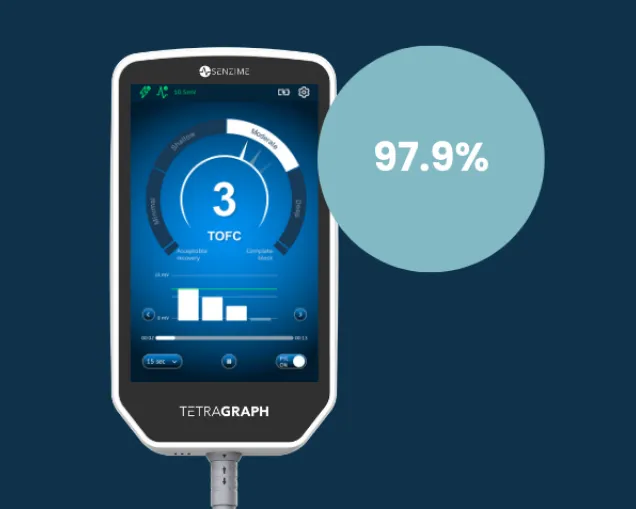
Clinical validation has demonstrated strong agreement between TetraGraph and mechanomyography (MMG), the golden standard for neuromuscular monitoring. In a 2024 study, Ebert et al. reported a mean bias of −2.1 percentage points between TetraGraph and MMG, corresponding to 97.9% accuracy when calculated as 100% minus the absolute bias.
The study was the first to validate a portable EMG-only monitor across all depths of neuromuscular block, including post-tetanic count (PTC). [4]
TwitchView has also been validated against MMG in peer-reviewed literature. In an earlier validation study, Bowdle et al. reported a mean bias of 4.7 percentage points between a prototype TwitchView electromyograph and MMG, equivalent to 95.3% when calculated using the same 100% minus absolute bias method. However, this published validation focused primarily on shallow and moderate levels of block rather than deep block monitoring using PTC. [2]
A separate study by Wedemeyer et al. found that TetraGraph and the other evaluated EMG monitors, including TwitchView, produced minimal overshoot and variability similar to MMG in patients who did not receive neuromuscular blocking drugs. [3]
Signal Processing Can Influence TOF Measurements
The systems also differ in signal-processing approach. TwitchView uses an area-under-the-curve (AUC) methodology, while TetraGraph uses peak-to-trough amplitude measurement. These differences may be more clinically relevant during deeper levels of neuromuscular block, when twitch amplitudes are lower and signal interpretation becomes more sensitive to filtering and noise-management strategies.
Neuromuscular monitors use proprietary software to convert an evoked electrical response into clinically reported values such as TOF count, TOF ratio, and post-tetanic count. Differences in waveform measurement, filtering, twitch-detection thresholds, and artifact rejection may therefore influence reported measurements, particularly when twitch signals are small.
Wedemeyer et al. evaluated noise filtering and twitch-amplitude thresholds using a laboratory-built mechanomyograph. Changing these parameters had little effect on TOF ratios but substantially affected TOF counts, with the greatest differences occurring during deeper neuromuscular block. The authors concluded that signal-processing choices are most likely to be clinically significant when counting low-amplitude twitch responses. [3]
“Differences in accuracy and precision are more likely to be noticeable at deeper levels of neuromuscular block when twitch amplitudes are lower, and noise management is more critical.” [3]
Because the study did not evaluate TetraGraph or TwitchView software directly, it cannot determine whether one commercial system’s noise-management strategy is superior. Instead, the findings reinforce the importance of evaluating each monitor through device-specific validation against an accepted reference method, particularly across deeper levels of block.
TetraGraph’s commercially available FDA-cleared device has been evaluated against mechanomyography across TOF ratio, TOF count, and post-tetanic count measurements. [4-6] Published TwitchView comparison data used a pre-commercial prototype and primarily evaluated TOF monitoring during shallow-to-moderate block; post-tetanic count was not included. [2] These differences in validation study design are relevant when assessing the evidence supporting each system’s performance across the full range of neuromuscular block.
Key Takeaways
- Signal-processing parameters can materially affect TOF counts, particularly when twitch amplitudes are low. [3]
- The Wedemeyer study does not directly compare the proprietary noise-management software used by TetraGraph and TwitchView. [3]
- Commercial-device validation is therefore important when evaluating monitor performance across different depths of neuromuscular block.
- TetraGraph’s commercially available device has been evaluated against MMG for TOF ratio, TOF count, and PTC. [4]
- Published TwitchView MMG validation used a pre-commercial prototype and did not include PTC evaluation. [2]
Feature-by-Feature Comparison
| Feature | TetraGraph (Senzime) | TwitchView (Blink)†‡ |
|---|---|---|
| Technology | EMG (peak-to-trough amplitude) | EMG (area under curve) |
| Accuracy vs. MMG | 97.9% agreement [4] | Validated against MMG [2] |
| Clinical validation | FDA-cleared commercial device validated against MMG across shallow, moderate, and deep levels of block including post-tetanic count (PTC), onset and recovery [3] | Published validation with pre-market prototype against MMG and AMG primarily evaluated for TOF count and ratio monitoring rather than deep block assessment; rapid onset and recovery periods were excluded from portions of comparison analysis [2] |
| One button startup | Yes | Yes |
| Objective sensor placement feedback | Yes (Signal Strength) | Not confirmed |
| Intubation readiness guidance | Yes (Intubation Readiness Indicator™ ) | Not available |
| Visual depth-of-block guidance | Yes (Level-of-Block Gauge™) | Not available |
| Trend Views | Yes | Yes |
| Auto PTC | Yes | Yes (AutoPTC™) |
| Stimulation modes | ST, TOF, PTC | ST, TOF, PTC |
| Tucked arm performance | Yes | Yes |
| Available Sensors | 3 different types (TetraSens Adult, TetraSens Pediatric, and TetraSensitive) | 3 different types (small, medium, and large) |
| Adult Sensor | Yes (smaller) | Yes (larger) |
| Pediatric Sensor | Yes | Yes |
| Electrodes | 4 | 5 |
| Monitor dimensions | 215x116x35 mm | 200x175x75 mm |
| Monitor weight | 748 g | 1300 g |
| Sensor box size | 303 x 104 x 48mm | 465 x 158 x 85mm |
| Battery life | 8 hours | 6 hours |
| Cable length | 12 ft / 18 ft options | 14 ft / 20 ft options |
| Mounting | Clamp from GCX® mounting solutions | TwitchArm (3 different sizes) & others |
| EMR integration | TetraCom™ universal HL7 connectivity designed for integration with major EHR platforms including Epic, Oracle Health (Cerner), and others | Epic, Cerner, Innovian and other EHR integrations; Blink states an open-interface commitment |
| OEM connectivity options | Capsule Neuron/Axon, Masimo IRIS/iSirona, Getinge Talis Hub, integrated via TetraCom™ | RS232/Ethernet data output via RJ45; Capsule/Draeger interface cable available, and others |
| Wireless HL7 capability | Available (via TetraCom) | Not available |
| FDA clearance | FDA 510(k) cleared | FDA 510(k) cleared |
| Pediatric options | Yes | Yes |
| Country of manufacture | Sweden | USA |
| Warranty | 7-year hardware warranty | 5-year hardware warranty |
†TwitchView® product information is based on publicly available sources reviewed by Senzime, including Blink Anesthesia/Blink Device Company materials at BlinkDC.com, the TwitchView System Operating Manual (PN00211 Rev O, issued January 15, 2025), and cited peer-reviewed publications. Information reflects publicly available sources as of October 7, 2026. Product features and specifications may change; refer to the manufacturer’s current product labeling and materials for the latest information.
‡Where a feature could not be identified in the publicly available sources reviewed, it is indicated as “Not confirmed” or “Not available,” as applicable.
Workflow and OR Integration — The Practical Differences
Beyond monitoring performance, operational and workflow considerations may also influence system adoption and day-to-day use in the OR.
Both TetraGraph and TwitchView are designed around wrist-based EMG monitoring workflows and support monitoring when the arm is tucked. Each system also offers automated TOF and PTC monitoring modes intended to integrate into routine perioperative practice.
There are, however, differences in hardware design and integration approach. TetraGraph utilizes a compact four-electrode sensor configuration and offers multiple cable length options along with GCX-certified mounting solutions. TwitchView utilizes a five-electrode sensor design and includes its own dedicated mounting platform called the TwitchArm.
The systems also differ in connectivity architecture. TetraCom enables universal HL7-based communication designed for integration with all major EHR platforms including Epic and Oracle Health (Cerner), while TwitchView supports EMR integration through proprietary interfaces.
In addition to monitor performance, institutions may evaluate practical considerations such as monitor footprint, sensor packaging size, storage requirements, mounting flexibility, cable management, and integration within existing perioperative workflows when comparing quantitative monitoring platforms.
Switching from TwitchView to TetraGraph — A Practical Guide
For institutions currently using TwitchView, transitioning to a new monitoring system may raise practical concerns. In many cases, however, the process is straightforward.
Both systems follow a similar workflow involving wrist-based electrode placement, initiation of stimulation, and interpretation of TOF data. As a result, staff familiar with TwitchView can typically adapt quickly to TetraGraph with minimal additional training.
Many hospitals also evaluate systems side-by-side during capital refresh cycles or clinical trials to compare workflow, usability, and integration within their own perioperative environment.
Conclusion
Both TetraGraph and TwitchView represent important advancements over subjective neuromuscular monitoring approaches and support current quantitative monitoring guidelines.
Meaningful differences exist. Institutions evaluating quantitative monitoring platforms may wish to consider not only TOF ratio performance, but also how each system performs during deep block management, real-world OR workflows, and enterprise-scale integration.
TetraGraph’s validation across all depths of neuromuscular block, compact four-electrode sensor design, universal HL7 connectivity, and advanced workflow guidance tools may offer advantages for institutions seeking a scalable quantitative monitoring platform across diverse perioperative environments.
Please note: This page is intended for healthcare professionals. It is primarily tailored to the U.S. market, but may also be relevant for other regions.
References
- Wedemeyer, Zain, et al. “Accuracy and Precision of Three Acceleromyographs, Three Electromyographs, and a Mechanomyograph Measuring the Train-of-Four Ratio in the Absence of Neuromuscular Blocking Drugs.” Anesthesiology, vol. 141, no. 2, Aug. 2024, pp. 262–271. https://doi.org/10.1097/ALN.0000000000005051.
- Bowdle A, Bussey L, Michaelsen K, Jelacic S, Nair B, Togashi K, Hulvershorn J. “A Comparison of a Prototype Electromyograph vs. a Mechanomyograph and an Acceleromyograph for Assessment of Neuromuscular Blockade.” Anaesthesia, vol. 75, 2020, pp. 187-195.
- Wedemeyer, Zain, et al. “The Effect of Excessive Noise Rejection, Noise Filtering and Twitch Threshold on Mechanomyograph Twitch Measurements.” Anaesthesia Critical Care & Pain Medicine, vol. 45, no. 3, May 2026, article 101780. doi:10.1016/j.accpm.2026.101780.
- Ebert, Thomas J., et al. “Train-of-Four Ratio, Counts and Post-Tetanic Counts with the Tetragraph Electromyograph in Comparison to Mechanomyography.” Journal of Clinical Monitoring and Computing, vol. 39, 2025, pp. 149–156. Springer Nature, doi:10.1007/s10877-024-01225-3.
- Iwasaki et al. A Comparison Between the Adductor Pollicis Muscle Using TOF-Watch SX and the Abductor Digiti Minimi Muscle Using TetraGraph in Rocuronium-Induced Neuromuscular Block: A Prospective Observational Study. Anesth Analg. 2022 Aug 1;135(2):370-375
- Sato et al. Comparison of two electromyography-based neuromuscular monitors, AF-201P and TetraGraph, in rocuronium-induced neuromuscular block: A prospective comparative study. Anaesth Crit Care Pain Med. 2022 Aug 31;41(6):101145