
Post-Tetanic Count Monitoring: Equipment Guide for Deep Neuromuscular Block
When train-of-four (TOF) count reaches zero, post-tetanic count (PTC) becomes the only reliable way to assess neuromuscular block depth. [1,4]
This guide explains when PTC monitoring is required, how to interpret PTC values in clinical practice, and the risks of managing deep block without it. It also outlines the equipment and workflow needed to safely manage deep neuromuscular block in complex surgical cases.
In many surgical cases, train-of-four (TOF) monitoring alone is not enough. When TOF count reaches 0, the patient is in profound neuromuscular block, and standard TOF monitoring can no longer distinguish the depth of block. At that point, post-tetanic count (PTC) is needed to assess deep block and estimate the return of TOF responses. [1,4]
Post-tetanic count (PTC) monitoring is the only way to assess block depth in these situations. Without it, clinicians are forced to estimate timing for redosing, reversal, and extubation. [4,6]
What Post-Tetanic Count Is and When You Need It
Post-Tetanic Count (PTC) is a quantitative neuromuscular monitoring mode (pattern) designed to assess the neuromuscular block deeper than moderate block (moderate block that is defined by the presence of 1, 2, or 3 of the 4 Twitches in TOF count). [1,4]
The sequence:
- 5-second tetanic stimulus applied to the ulnar nerve [1]
- 3-seconds later, up to 20 single twitch stimulations [1]
The PTC is the total number of detectable muscle responses elicited by the tetanic stimulation. [1]
The number of responses (0–20) indicates proximity to recovery, with 0 indicating a total neuromuscular block. [1,4]
Clinical interpretation:
- PTC 10: Halfway to the return of a twitch
- PTC >2: Diaphragm movement can occur.
- PTC 0: Complete block; diaphragm relaxation.
This relationship provides a predictive window into recovery, not just a snapshot. [1,4] This measurement scale aligns with the American Society of Anesthesiology’s (ASA) guidelines and is reflected in the TetraGraph® Level-of Block Gauge™ in the next-generation device.
Without PTC, clinicians are effectively “flying blind” during the most critical phase of neuromuscular management.
Clinical Situations Requiring PTC Monitoring
PTC monitoring is essential in procedures requiring deep or sustained neuromuscular block [4]:
Laparoscopic and robotic-assisted (RAS) abdominal surgery
- Deep block (PTC 0-1) improves surgical conditions [4]
- Enables better insufflation and reduced abdominal wall resistance
Ophthalmic surgery
- Requires absolute immobility
- PTC = 0 confirms profound block
Neurosurgical procedures
- Even minor movement can compromise outcomes
Rapid sequence induction (RSI)
- Confirms adequate block before airway manipulation
Obese patients
- Rocuronium pharmacokinetics are highly variable
- PTC helps avoid under- and over-dosing
Key insight: Deep block is often clinically desirable, but only safe when objectively and quantitatively monitored.
The Risk of Managing Deep Block Without PTC
Managing deep neuromuscular block without PTC introduces predictable and preventable errors:
- Unintentional redosing during recovery
Patients may regain diaphragmatic function before peripheral muscle recovery. [5] A patient at PTC 9 or TOF 1 may begin breathing, which can be misinterpreted as inadequate relaxation, leading to unnecessary redosing [5].
Incorrect reversal timing
Sugammadex dosing is depth-dependent (ASA guidelines) [6,7]:- 4 mg/kg → deep block (PTC ≥1, TOF 0)
- 2 mg/kg → moderate block (TOF 1–3)
Attempting reversal without PTC data risks underdosing or delayed recovery.- Unpredictable extubation timing
Without PTC, clinicians cannot anticipate when TOF will return, leading to delays or premature extubation decisions.
Summary: PTC is not optional; it is required for safe, controlled deep block management. [4]

Equipment Considerations for PTC Monitoring — What to Look For
Not all monitors handle PTC effectively.[4] Key considerations include:
- Integrated PTC mode
- Built into the same device as TOF monitoring
- Built into the same device as TOF monitoring
- TOF/PTC switching
- Eliminates manual switching
- Reduces user error during transitions
- EMG-based measurement
- Works with tucked arms in laparoscopic/robotic cases
- Avoids AMG limitations (free thumb required) [4]
- Quantitative output
- PTC count (0–20)
- TOF count and ratio (%)
- Trend visualization
- Displays recovery trajectory across the case
- Displays recovery trajectory across the case
- Electronic Health Record (EHR) integration
- Automated documentation via HL7
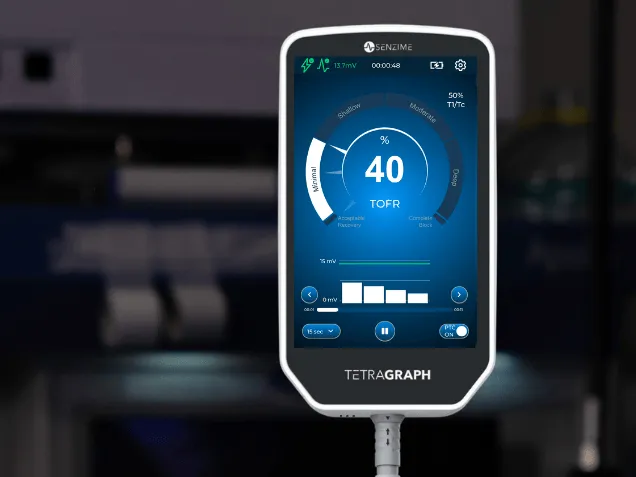
TetraGraph® EMG has demonstrated excellent agreement with mechanomyography across TOF ratio, TOF count, and post-tetanic count measurements, including deep neuromuscular block. [2] Its portable design, accuracy at all levels of block, and simplicity of use make it an ideal tool for neuromuscular monitoring in clinical settings [2]
TetraGraph meets all criteria:
- Only portable, EMG-based monitor clinically validated at deep block (PTC)
- Built-in PTC mode with automatic switching
- EMG-based measurement in all patient positions
- FDA-cleared [8]
- Trend visualization
- Electronic health record (EHR) integration
- Integrated workflow across deep and moderate block
Deep Block Management Protocol — A Practical Framework
A structured approach ensures safe and efficient deep block management:
Induction
- Rocuronium Bromide 0.6–1.2 mg/kg
- TOFC 0 expected within 2–5 minutes
Clinical duration varies considerably depending on patient characteristics, anesthetic technique, and procedural factors [3].
- Monitor progression to deep block
- Verify TOF count of 4 before NMBA administration or incision
- When the TOF count reaches 0, use PTC monitoring to assess deep neuromuscular block
- Maintenance phase
- Target PTC 0-1 for optimal surgical conditions [4]
- Target PTC 0-1 for optimal surgical conditions [4]
- Redosing decision
- PTC approaching 20 → TOF return imminent [1,4]
- If surgery ongoing: consider redosing
- If nearing end: allow spontaneous recovery
- PTC approaching 20 → TOF return imminent [1,4]
- Reversal
- When PTC ≥1 → administer sugammadex 4 mg/kg [6,7]
- When PTC ≥1 → administer sugammadex 4 mg/kg [6,7]
- Extubation
- Confirm TOF ratio ≥0.9 (ASA guidelines) [6]
This approach eliminates guesswork and aligns with modern quantitative monitoring standards.
This guide is based on published literature. Clinicians should use their own judgment.
Take the Next Step
PTC monitoring is essential for managing deep neuromuscular block safely and effectively.
Explore complete buying guide
to learn why quantitative monitoring is essential at all block depths
Request TetraGraph Technical Specifications
to evaluate PTC-capable monitoring.
Schedule a Deep Block Management Demo
to see how automated PTC and TOF integration work in real OR conditions.
Please note: This page is intended for healthcare professionals. It is primarily tailored to the U.S. market, but may also be relevant for other regions.
References
- Viby-Mogensen J, et al. Posttetanic count (PTC): a new method of evaluating an intense nondepolarizing neuromuscular blockade. Anesthesiology. 1981;55(4):458-461. PMID: 7294384.
- Ebert TJ, et al.: Train-of-four ratio, counts and post-tetanic counts with the TetraGraph electromyograph in comparison with mechanomyography. Journal of Clinical Monitoring and Computing, 2024.
- Debaene B, et.al. Residual paralysis in the PACU after a single intubating dose of nondepolarizing muscle relaxant with an intermediate duration of action. Anesthesiology. 2003;98(5):1042–1048.
- Naguib M, et al. Consensus statement on perioperative use of neuromuscular monitoring. Anesth Analg. 2018;127(1):71-80. doi:10.1213/ANE.0000000000002670.
- Dhonneur G, et al. Post-tetanic count at adductor pollicis is a better indicator of early diaphragmatic recovery than train-of-four count at corrugator supercilii. Br J Anaesth. 2007.
- Thilen SR, et al. Management of muscle relaxation with rocuronium and reversal with neostigmine or sugammadex guided by quantitative neuromuscular monitoring. Anesth Analg. 2023.
- Merck & Co., Inc., Bridion® dosing considerations.
- U.S. Food and Drug Administration. 510(k) Premarket Notification Database. K190795 (2019); K220530 (2022), K261098 (2026).